
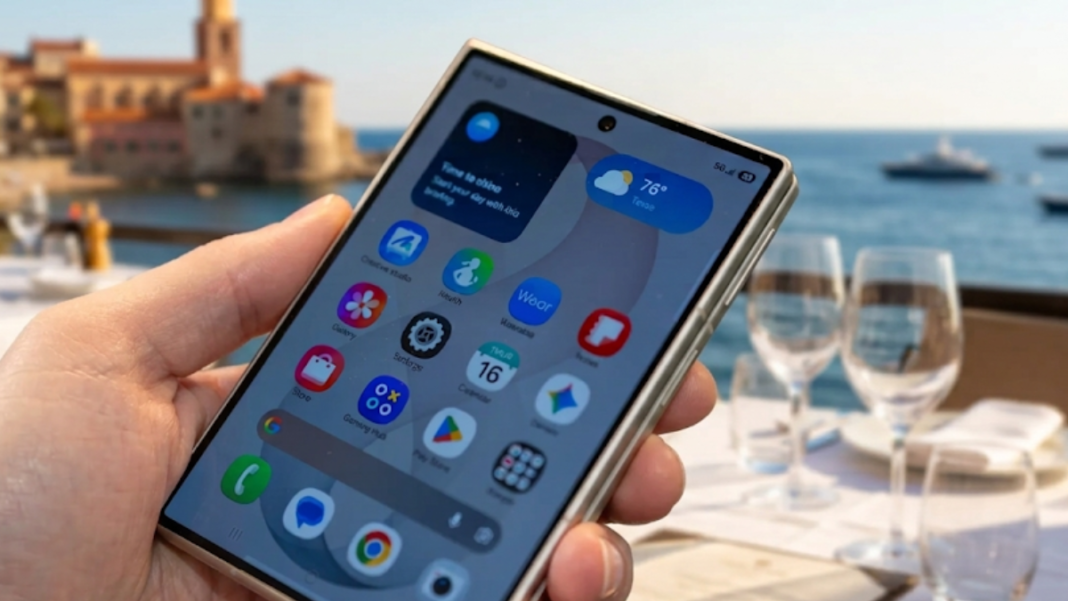
The wider foldable was always the correct form factor. Google understood this when it launched the original Pixel Fold in 2023 — a device that, for all its flaws, had the proportions right. It opened to something approaching a usable screen rather than a tall, narrow strip that made every app look like it was peering through a letterbox. Then Google abandoned the idea, pivoted to a taller design, and the rest of the industry followed Samsung’s lead. Three years on, Samsung has quietly adopted the very form factor Google left behind — and built it properly.
The Short Version
The Galaxy Z Fold 8 is the first foldable that genuinely disappears into your life. At 201g with a passport-style wider aspect ratio, it sits in a trouser pocket without complaint, opens to a 7.6-inch screen with a near-invisible crease, and handles daily photography without the telephoto lens most people will never miss. Samsung has taken a decade of foldable experience and produced something that feels less like a tech novelty and more like the way phones should have always worked. From £1,699.
The Form Factor Google Abandoned
I owned the original Pixel Fold. For all its problems — the weight, the clunky build, the sense that you were carrying an engineering prototype rather than a finished product — it had the right idea. A wider, shorter device that opened to a screen with proportions suited to actually watching, reading, and working on. When Google moved away from that design, and when none of the other big western market manufacturers picked it up, it felt like a missed opportunity being buried by short-sighted thinking.
The Galaxy Z Fold 8 is the vindication. Samsung has arrived at the same passport-style proportions, but with the benefit of a decade of foldable manufacturing, advances in materials science, and — critically — the discipline to make the device thin and light enough that the form factor works in practice, not just in theory. The original Pixel Fold weighed 283g. The Fold 8 weighs 201g. That is not a marginal improvement; it is a different category of object.
A Phone You Actually Carry
This is where most foldable reviews miss the point. Specifications matter, but the question that determines whether a foldable succeeds is brutally simple: will you actually take it with you?
My previous device, a Pixel Fold 10, was like carrying a brick. During the summer months — when you are going out in a shirt and linen trousers, not a jacket with deep pockets — I would regularly leave it at home. If I genuinely needed the phone, I would have to take a bag or a jacket specifically to accommodate it, which rather defeats the purpose of owning a portable device. The phone was dictating my wardrobe. That is absurd.
At 9.7mm folded and 201g, the Fold 8 is not meaningfully thicker or heavier than a flagship slab phone. Unfolded, at 4.5mm, it is thinner than most people’s phone cases. Samsung has crossed the threshold where a foldable no longer asks you to make compromises for the privilege of a larger screen — you just get the larger screen.
The Display
The 7.6-inch inner screen has the aspect ratio that the wider form factor was always meant to deliver. Video content fills the screen properly. Split-screen multitasking — running, say, a browser alongside a messaging app — feels natural rather than cramped. Samsung’s One UI 9 makes the most of this with a three-app split layout and a persistent taskbar that, for the first time on a phone, makes the inner screen feel like a genuinely productive workspace rather than a gimmick.
The crease, historically the foldable’s most visible concession to physics, has been reduced to near-invisibility. Samsung’s Flex Titanium hinge places a titanium-alloy plate beneath the display, and in normal use — watching video, scrolling, reading — you simply do not notice it. Under direct bright light with the screen off, you can find it if you look. During actual use, it is a non-issue. Peak brightness hits 3,000 nits, and the anti-reflective coating cuts glare by roughly half compared to the Fold 7. In outdoor use on a bright July afternoon, the screen remains entirely legible.
Camera: The Telephoto Question
The Fold 8 ships with two rear cameras: a 50MP main sensor and a 50MP ultrawide. No telephoto. This is the point where most tech reviews will wring their hands and declare it a dealbreaker on a £1,699 device. Allow me to disagree.
I have spent four days taking the kind of photographs that most people actually take — cars spotted on the street, meals worth remembering, friends at dinner, clothes I was considering buying. Not once did I reach for a zoom that was not there. The 50MP main camera is sharp, fast, and handles low light without the processing artefacts that plagued earlier Fold cameras. 4K video at 60fps is smooth and well-stabilised. For the way most people use a phone camera — which is to say, casually and at conversational distance — this is more than adequate.
Battery and Performance
The 4,800mAh silicon-carbon battery is a meaningful step forward. Samsung’s adoption of silicon-carbon cell chemistry means greater capacity without additional bulk — a trade-off that matters enormously in a device where every millimetre counts. In four days of use, including a fair amount of unfolded browsing, video, and photography, the phone has consistently finished the day above 30%. It is not class-leading endurance, but it is the first time a Fold has not produced end-of-day battery anxiety.
The Snapdragon 8 Elite Gen 5 chipset handles everything without hesitation. Apps open immediately, multitasking is seamless, and the device never runs warm during normal use. Samsung claims 45W wired and 20W wireless charging; in practice, a twenty-minute charge over lunch adds enough to see you comfortably through the evening.
Build Quality and Durability
The hinge is rated for 500,000 folds — roughly 685 opens per day for two years, which is to say, well beyond what any reasonable person will subject it to. The mechanism is smooth and confident, with none of the looseness that earlier Samsung foldables sometimes developed. There is a trade-off: the Fold 8 does not hold itself at arbitrary angles the way previous models did, which means flex-mode use (propping the phone half-open as a miniature laptop) is no longer an option. Given that flex mode was always more of a party trick than a daily-use feature, this seems a sensible exchange for a more robust hinge.
IP48 water and dust resistance is adequate rather than exceptional — it will survive rain and a splashed drink, but this is not a phone to take to the beach without care.
Key Specifications
| Inner display | 7.6-inch, 120Hz, 3,000 nits peak |
| Cover display | 5.5-inch, 120Hz |
| Processor | Snapdragon 8 Elite Gen 5 for Galaxy |
| RAM / Storage | 16GB / 256GB, 512GB, or 1TB |
| Rear cameras | 50MP main (f/1.8) + 50MP ultrawide (f/1.9) |
| Battery | 4,800mAh silicon-carbon, 45W wired, 20W wireless |
| Weight | 201g |
| Dimensions (folded) | 123.9 × 81.9 × 9.7mm |
| Dimensions (unfolded) | 123.9 × 161.4 × 4.5mm |
| Durability | IP48, 500,000-fold hinge rating |
| Software | One UI 9.0, 7 years of updates |
| Price | From £1,699 |
The Ultra Question
Samsung has, for the first time, split the Fold line into two tiers. The Fold 8 Ultra, at £1,899, adds a 200MP main camera with telephoto, a larger 8-inch inner display, and slightly more heft at 215g. The £200 premium buys you a materially better camera system and a marginally larger screen.
For the Men of Means reader, the decision is straightforward. If photography is central to how you use your phone — if you are the sort of person who shoots product for social media, documents travel in detail, or simply wants the best camera available in a foldable — the Ultra justifies the premium. If, like most people, your phone camera is a tool of convenience rather than craft, the standard Fold 8 is the smarter buy. You save £200, gain a lighter device, and lose nothing that will affect your daily experience.
The Unveiling
Samsung presented the Fold 8 at Galaxy Unpacked on 22 July. The segment below covers the Fold 8 reveal — worth watching for the form factor comparison alone.
The Verdict
The Galaxy Z Fold 8 is the foldable that finally makes the case for foldables. Not through specification escalation or novelty, but by solving the problems that have kept sensible people buying slab phones: weight, bulk, crease visibility, and the nagging sense that you were carrying a compromise. At 201g with a passport-style aspect ratio that makes video, multitasking, and reading genuinely better, the Fold 8 is the first device in this category that asks for no concessions. Samsung has taken a form factor that Google understood but could not execute, and built it with the precision and restraint of a company that has been refining mobile hardware for longer than most of its competitors have existed.
It is not cheap. At £1,699 it sits firmly in flagship territory, and the absence of a telephoto lens at this price will irritate a vocal minority. But for the majority of buyers — those who want a larger screen without a larger phone, who dress for summer without planning around their device, who take photographs of life as it happens rather than as a technical exercise — this is the phone to buy in 2026.


